Private-Label Jewelry Care Kits: Cloth, Pouch and Packaging Choices
Build a practical care accessory around your jewelry collection, with a clear component list and packing brief.
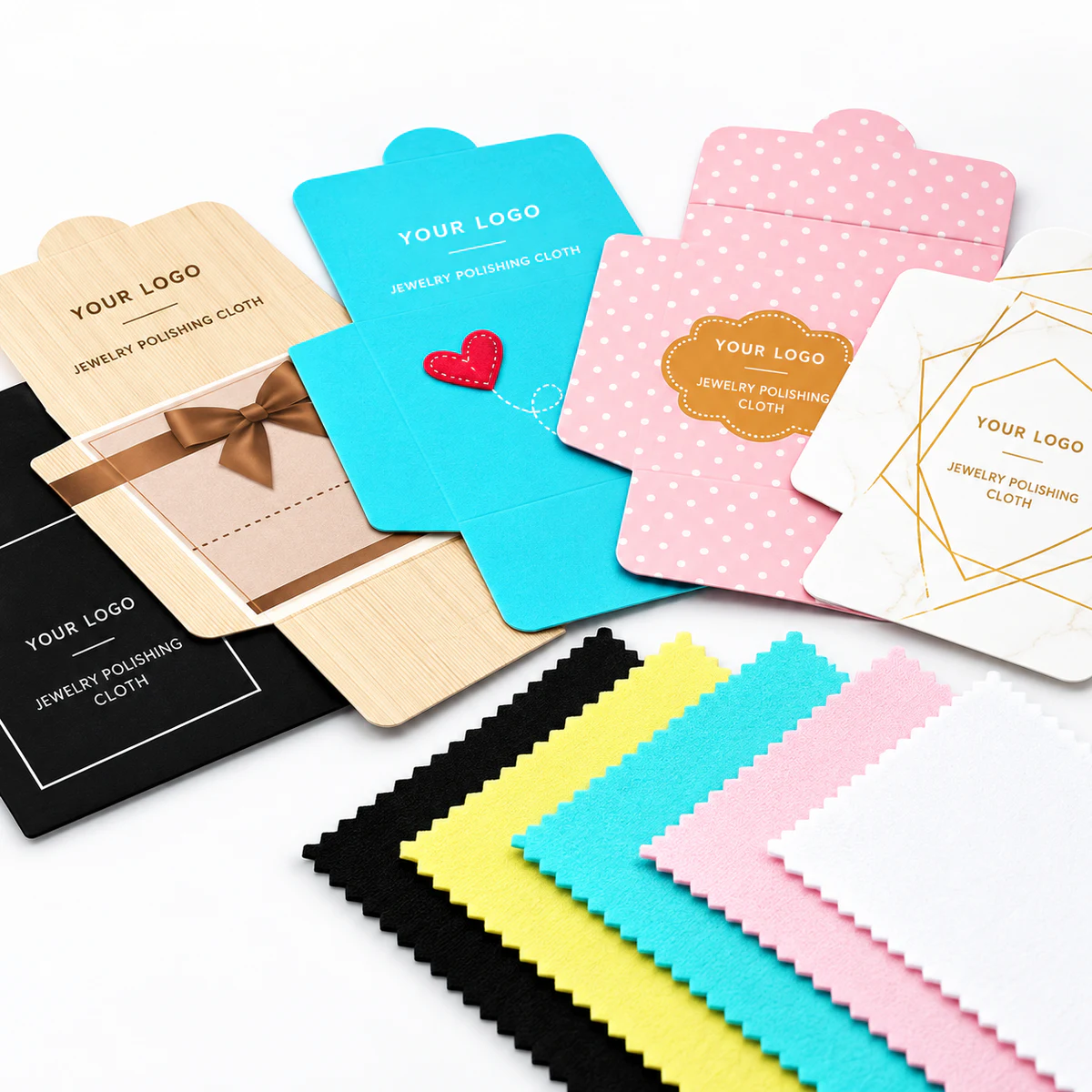
The short answer: start a private-label jewelry care kit with one clearly specified care cloth, the packaging needed to protect and present it, and product-specific instructions. Add a pouch or box only when it serves the customer's use or your retail format. Quote the complete component list, including assembly, instead of comparing cloth prices alone.
For a jewelry brand or wholesaler, a care accessory can accompany a new purchase, become a separately sold item or form part of a retailer's presentation. These are different buying briefs. The examples below are planning formats, not claims that Qula holds a finished kit in stock or guarantees a particular marketing result.
Choose the format around the purchase
| Format | Decisions to make |
|---|---|
| Cloth in a printed sleeve A compact care insert supplied with jewelry. | Folded cloth size, sleeve fit, visible logo, instructions and how it fits in the existing jewelry box. |
| Cloth with a reusable pouch A presentation that includes a separate storage accessory. | Whether the pouch holds jewelry, the cloth or both; internal space, closure and branding on each component. |
| Cloth in a presentation box A format for a separately presented care accessory. | Internal dimensions, insert or restraint, product label, outer packing and whether assembly is included. |
Compare custom printed cloth packaging and individually packaged cloths for compact formats. For a pouch-led presentation, review metallic drawstring jewelry pouches. Confirm availability, customization and quantity requirements for the exact combination rather than assuming separate product listings form a pre-assembled set.
Write the bill of materials before requesting prices
A bill of materials is simply a list of what belongs in each finished unit. It helps a buyer compare quotes that might otherwise include different things. Record each component, its quantity per kit, specification and responsible supplier.
- Cloth: intended surface, confirmed treatment or construction, open size, folded size, color and logo.
- Primary packaging: sleeve, pouch or box, finished dimensions, material specification and artwork.
- Instructions: approved wording, language, print location and any separate card.
- Assembly: folding, insertion, closing, labeling and inspection, with responsibility assigned.
- Shipment packing: units per inner pack, carton arrangement and carton identification.
A missing assembly line can matter as much as a unit-price difference. Ask whether goods arrive as loose components or finished packed units. For multiple retailers or countries, state which artwork, labels or components differ in each variant.
Make the care information product-specific
Approve the cloth first, then write the instructions for that exact specification. State the intended use and relevant exclusions. Do not transfer instructions from a lens cloth to a treated silver polishing cloth, and do not imply that a pouch has anti-tarnish properties merely because it holds jewelry.
Keep marketing claims separate from confirmed technical information. Terms such as "safe for all jewelry," "chemical-free" or "eco-friendly" need a sound, product-specific basis; attractive packaging is not evidence. Read our polishing cloth and lens cloth comparison before combining different care products under one design.
Plan language variants without losing version control
Use a variant matrix for regional launches: destination, pack language, artwork file, barcode if required by your retailer, and quantity. English may suit one customer; another may request Spanish, Portuguese, French or German. Ask the buyer to approve the final translation and any local labeling requirements instead of assuming one language covers a continent.
For US, European, Australian and South American shipments, identify the actual delivery city and postal code, not only a region. Request a quote stating its currency, delivery basis, included services and exclusions. Any customs or tax assumptions should be confirmed separately for the destination and agreed shipping arrangement.
Approve one complete unit before the bulk run
Review a finished sample with all intended contents inside. Check the folded logo position, whether instructions are readable, pouch closure or sleeve fit, label accuracy and the order in which components are packed. Record the approved reference and the artwork versions used.
For an illustrative RFQ, write: "Please quote a branded jewelry-care cloth with a printed sleeve, and an alternative adding a drawstring pouch. Use the attached dimensions and logo. Separate component and assembly prices, confirm MOQ per version and sample costs, and quote delivery to [destination] for our target arrival date." No size, quantity or lead time in this example is a stock promise.
Buyer questions
Can I order the cloth and packaging together?
Send Qula the complete component list and packing instructions for review. Confirm the exact combination, assembly service, MOQ and pricing in the quotation; separate catalog products do not automatically constitute a ready-made kit.
What should a brand approve before mass production?
Approve the product specification, complete packed sample, logo and packaging artwork, care wording, variant quantities and inspection requirements. Keep one agreed version of each document for the production order.
Request an OEM/ODM cloth and packaging quotation with your component list, quantity per version and delivery destination.